
The knee is often called a “dumb joint” in physical fitness circles. It’s called that because the knee is heavily influenced by what’s happening at the ankle and hip. So when you have knee pain when squatting and think the knee is the problem, you could be looking for a solution in the wrong place.
Let’s first discuss your squat depth. If you have been doing half squats and half lunges for most your life, (the kind where you don’t get your thighs parallel to the ground,) you are training the upper fibers of the four quadricep muscles. The upper fibers are closest to the hip joint. These muscle fibers can become overactive while the lower fibers go underused. The lower fibers are closest to the knee joint. They get recruited more when you squat to parallel or lower.
Watch this video for demonstration.
You may need assistance to practice getting more range of motion in your squats. Using a TRX or broomstick is a great way to provide balance. I also like doing sit to stand squats using a low chair or bench. You can sit down without the risk of falling down because the seat will be there!
The second muscular reason why your knee might hurt is due to muscular imbalance with the inner and outer thigh muscles. Our inner and outer thigh muscles attach at the hip. And remember, the knee is affected by the very mobile hip joint.
Take a look at the gracilis muscle. This inner thigh muscle adducts the hip and flexes the knee. If your knee pain when squatting is on the inside of your knee, this muscle might be overactive or underactive.
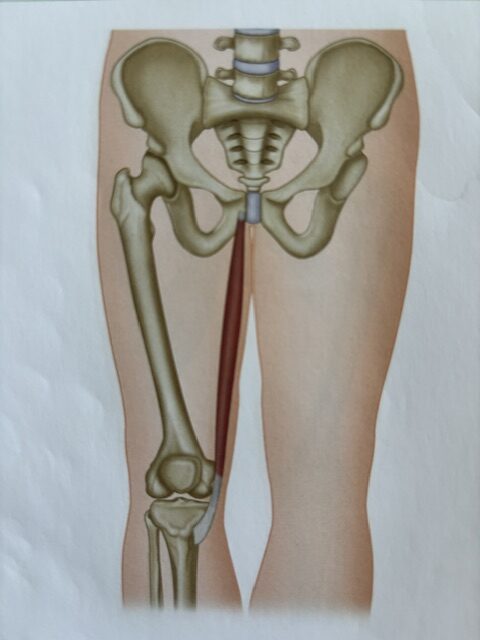
Because the outer thigh muscles and inner thigh muscles do opposing movements, they are in a close relationship with each other. This is why testing the relationship between them is important.
In my Neurokinetic Therapy appointments, I test the muscles for how they are talking to each other. I often find that the outer thigh (tensor fascia latae or gluteus medius) is overactive while the gracilis or others are underactive. However, the opposite situation could be true too. That’s why I test, don’t guess. Once I determine which way the pattern is presenting, I assign the correct exercises to do as homework to resolve the imbalance.
Overactive muscles need to be released either through self-myofascial release such as foam rolling or through massage. Stretching usually isn’t effective in these cases.
Please note that foam rolling your IT Band hurts like crazy and is ineffective. The IT Band is the tendon that runs from the outer thigh muscles to the outside of the knee. So it’s the outer thigh muscles that need to be massaged, not the IT Band.
The last muscle to be aware of when it comes to knee pain when squatting is the popliteus. The popliteus is a tiny muscle directly behind the knee. It’s job is to unlock the knee, meaning if your knee is very straight, it does the work of starting to bend it.
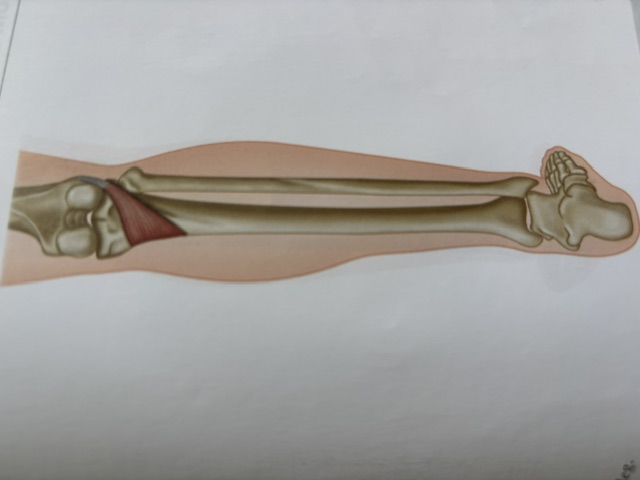
Little muscles have a tendency to have “Napoleon Syndrome.” The popliteus gets neurologically overactive and tries to do the work of the quadriceps, glutes, or hamstrings. When a little muscle tries to do the job of 3-4 big muscles, it gets angry and shouts in pain. You might be surprised at how tender it can be to touch. But you would also never know it’s there until you start feeling around behind the knee.
Meniscus tears, arthritis, and a number of other non-muscular issues may be the reason that you have knee pain when squatting. If you have surgical scars on or around your knee, they can play into knee pain as well. Check out this blog for more information.